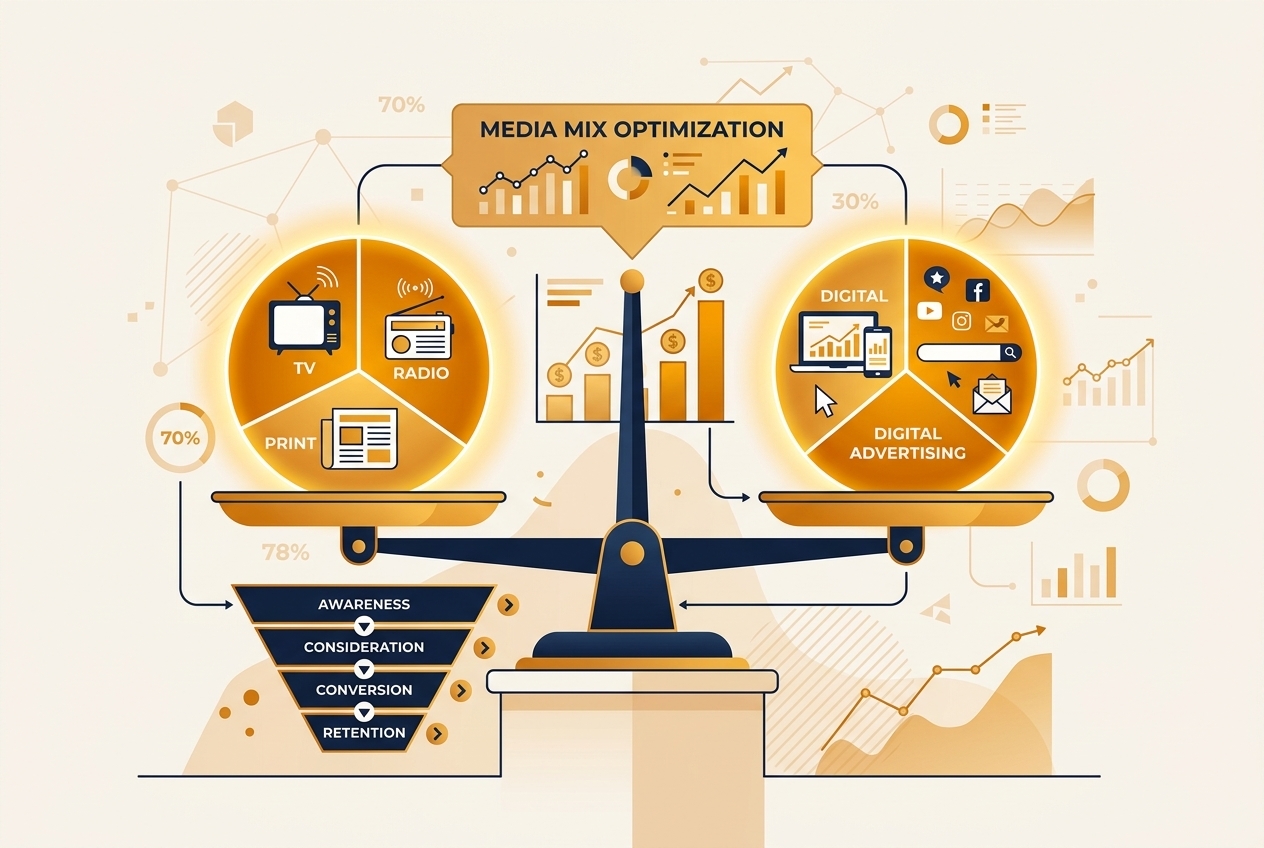
The debate between digital and traditional advertising is a false dichotomy. The most effective campaigns don't choose one over the other — they strategically blend both to maximize reach, frequency, and conversion across the entire customer journey.
India's advertising market, valued at over ₹1 lakh crore, is split roughly 45% digital and 55% traditional (TV, print, OOH, radio). But the most successful brands aren't looking at channel splits — they're looking at audience touchpoints.
The Complementary Power of Multi-Channel
Research from Nielsen consistently shows that campaigns using three or more media channels deliver 250% better ROI than single-channel campaigns. The reason is simple: different media serve different purposes in the purchase funnel.
TV builds broad awareness and emotional connection. Print delivers credibility and detailed messaging. OOH provides repeated exposure and geographic targeting. Radio offers frequency and local relevance. Digital enables precision targeting, interactivity, and measurable conversions.
A Framework for Budget Allocation
Rather than starting with channel percentages, start with your campaign objectives. For brand awareness campaigns, allocate 40% to TV/OOH for reach, 30% to digital video for frequency, and 30% to print/radio for credibility. For performance campaigns, shift to 60% digital, 20% OOH for local reinforcement, and 20% print for trust-building.
The 70-20-10 rule is a useful starting point: 70% of budget on proven channels, 20% on emerging channels, and 10% on experimental formats. As you gather data, optimize the split based on actual performance.
Measuring Cross-Channel Effectiveness
The biggest challenge with multi-channel campaigns is attribution. Use marketing mix modeling (MMM) to understand the incremental contribution of each channel. Complement this with brand lift studies and controlled geo-experiments to validate results.
Track cross-channel metrics like total reach (unduplicated audience across all channels), effective frequency (how many times your target audience saw your message across channels), and blended cost per acquisition (total spend divided by total conversions regardless of channel).
The brands that win aren't the ones spending the most — they're the ones spending most intelligently across the right mix of channels for their specific audience and objectives.